
Few street foods are as beloved around the world as falafel. Crispy on the outside, tender and herb-packed inside, these golden chickpea fritters are a cornerstone of Middle Eastern cuisine. Found everywhere from the busy food markets in Cairo to trendy New York food trucks, falafel is global comfort food, served stuffed in pita, scattered over salads or dipped into tahini sauce and/or another popular sauce.
Here I will show you just how easy it is to make falafel at home!

A Little History of Falafel
Falafel’s exact origins are debated, but most food historians agree it likely began in Egypt, where it was originally made with fava beans. From there, the recipe spread across the Middle East, with variations appearing in Lebanon, Israel, Syria and beyond.
Today, Egyptian falafel (ta’ameya) often still uses fava beans, while the Levantine version relies on chickpeas. Both are authentic, and both are delicious. Chickpea-based falafel has become the most common internationally, especially in Europe and North America.
Ingredients
Fresh ingredients are key to getting the best flavour from this falafel recipe. You’ll find the ingredients listed below, while the precise amounts are provided in the recipe card at the end of the page. For smooth cooking and the best outcome, it’s a good idea to have everything measured and prepared before you begin.

See recipe card for quantities.
- Dried chickpeas
- Flat leaf parsley
- Fresh dill
- Fresh coriander leaves
- Onions
- Garlic
- Ground cumin
- Ground coriander
- Salt
- Black pepper
- Pul biber
- Baking powder
- White sesame seeds
Step by step photos
Below, you’ll see step-by-step photographs to guide you through this felafel recipe. At the bottom of the page, you’ll also find the full recipe card, which includes the complete list of ingredients and written instructions in an easy, printable format.

- Step 1: Wash and then cover the chickpeas with at least 2 inches of water to soak for 24 hours. Strain and set aside.

- Step 2: Blend all of the ingredients in a food processor or blender until you have a thick green paste. Depending on your food processor, it might be easier to do this in batches and then mix it all together at the end.

- Step 3: When you have a thick paste, place it in the fridge for at least an hour. The falafel patties will be easier to form when cold.

- Step 4: Just before forming into patties, add the sesame seeds and stir them in.

- Step 5: Form the falafel paste into small patties. These patties freeze really well so if you can freeze some for later if that is more convenient.

- Step 6: Heat a thin layer of oil in a non-stick frying pan over a medium-high heat. Fry without turning for about 3 minutes and then flip the patties over to brown the other side and heat the felafel through.

- Step 7: You'll know when the falafel are ready to flip over when they are lightly browned and crispy on the bottom side.

- Step 8: If you tear a falafel open, you will see the steaming hot green centre. These are too good!
- Step 9: Place the hot falafel on flatbreads or just eat them on their own. Be sure to taste and add more salt if needed.

- Step 10: These falafel are amazing stock high on flatbreads, with salad vegetables, kebab shop red sauce and taum (garlic sauce)
Variations Around the Middle East
- Egyptian Falafel (Ta’ameya): Made with fava beans instead of chickpeas. It's a different flavour but equally is good.
- Stuffed Falafel: Some Syrian versions are stuffed with onions, peppers or chilli paste.
- Baked or Air-Fried Falafel: A modern twist for those avoiding deep frying. Not as crispy, but still tasty. I was asked a few times if this would work so I gave it a try. 10 minutes at 200°C/400°F should do the job.
Equipment You’ll Need
Food Processor: Essential for pulsing the chickpeas and herbs into a coarse, grainy mixture. Don’t use a blender—it will puree instead of chop.
Large Bowl: For mixing and resting the falafel dough.
Falafel Scoop or Two Spoons: A falafel scoop makes perfectly round patties, but two spoons or your hands work fine.
Heavy Pot or Deep Fryer: To maintain steady oil temperature. A cast iron pot is excellent.
Serving Size (Serves up to 10)
This recipe is set up for up to 10 servings. You can easily upscale or downscale the recipes in you like. I like to prepare this large batch of falafel because it isn't much more work than making a smaller amount and it freezes really well.
Storage and Reheating Falafel
Falafel tastes best fresh, but you can store leftovers:
Refrigeration: Store cooled falafel in an airtight container in the fridge for up to 3 days.
Freezing: Freeze uncooked falafel mixture (before shaping) in freezer bags for up to 1 month. You can also freeze cooked falafel, but they lose some crispness.
Reheating: Reheat in a hot oven (190°C / 375°F) for 10 minutes or in an air fryer. Avoid microwaving—it makes falafel soggy.
Pro Tips
- Keep the texture coarse: Don’t blend into a fine, smooth paste. The mixture should be slightly grainy.
- Chill before frying: Refrigerating the mixture helps falafel hold together.
- Test the oil temperature: Too hot and they burn outside but stay raw inside; too cool and they absorb oil. Aim for 180°C (350°F).
- Don’t overcrowd the pan: Fry in small batches to maintain oil temperature.
- Serve immediately: Falafel loses crispness as it sits. Fry them just before serving.
Top Tip
Use dried, not canned chickpeas: Canned chickpeas are too soft and watery. Your falafel will fall apart. Always soak dried beans overnight.
FAQ
Yes, but they won’t be as crispy. Brush with oil and bake at 200°C (400°F) for 20–25 minutes, flipping halfway. An air fryer also works well too and will cook the falafel faster.
This usually means the mixture is too wet, the chickpeas were cooked instead of soaked, or the oil isn’t hot enough. Add a spoonful of flour if needed and make sure the oil is at 180°C (350°F).
I don’t recommend doing this. They’re too soft and result in mushy falafel. For authentic texture, always use dried chickpeas.
Related
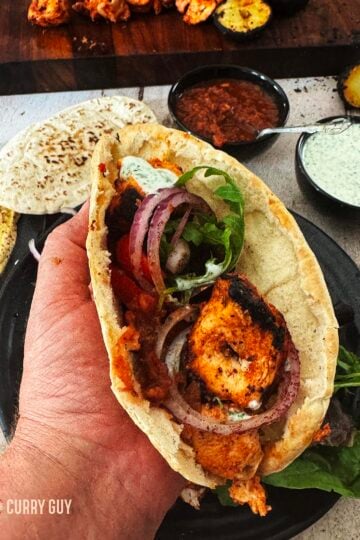
Looking for other recipes like this? Give one of these delicious wraps a try.


Pairing
These are my favorite dishes to serve with falafel:


Have you tried this felafel recipe?
If yes, please give it a star rating in the recipe card below and leave a comment. I love receiving your feedback and I’m sure other readers of my blog do too. Thank you.
If you are not already doing so, please follow The Curry Guy on Instagram and Facebook for all our latest recipes.
Falafel
This authentic and delicious felafel recipe could not be easier to make. You will need to plan ahead though. The dried chickpeas need to soak for 24 hours. Do not use cooked chickpeas.
Ingredients
- 575g ( 2 1/2 cups) dried chickpeas
- 60g (1 1/2 packed cups) flat leaf parsley
- 25g (3/4 cup) fresh dill
- 30g (3/4 cup) fresh coriander leaves
- 2 medium onions, roughly chopped
- 8 garlic cloves, smashed
- 1 tbsp ground cumin
- 1 tbsp ground coriander
- 1 tbsp salt
- 1 tbsp black pepper
- 1 tbsp pul biber
- 2 tsp baking powder
- 3 tbsp white sesame seeds
- 5 tbsp vegetable oil
Instructions
- Wash and then cover the chickpeas with at least 2 inches of water to soak for 24 hours. Strain and set aside.
- Blend all of the ingredients up to and including the baking powder in a food processor or blender until you have a thick green paste. Depending on your food processor, it might be easier to do this in batches and then mix it all together at the end.
- When you have a thick paste, place it in the fridge for at least an hour. The felafel patties will be easier to form when cold.
- Just before forming into patties, add the sesame seeds and stir them in.
- Form the felafel paste into small patties. These patties freeze really well so if you can freeze some for later if that is more convenient. I form mine into about 3 inch circular patties but the size and shape is really down to you.
- Heat a thin layer of oil in a non-stick frying pan over a medium-high heat. Fry without turning for about 3 minutes and then flip the patties over to brown the other side and heat the felafel through.
- You'll know when the felafel are ready to flip over when they are lightly browned and crispy on the bottom side.
- You'll know when the felafel are ready to flip over when they are lightly browned and crispy on the bottom side.
- Place the hot felafel on flatbreads or just eat them on their own. Be sure to taste and add more salt if needed.
- These felafel are amazing stock high on flatbreads, with salad vegetables, kebab shop red sauce and taum (garlic sauce).
Recommended Products
As an Amazon Associate and member of other affiliate programs, I earn from qualifying purchases.


Nutrition Information:
Yield:
10Serving Size:
1Amount Per Serving: Calories: 190Total Fat: 10gSaturated Fat: 1gTrans Fat: 0gUnsaturated Fat: 8gCholesterol: 0mgSodium: 808mgCarbohydrates: 21gFiber: 6gSugar: 4gProtein: 7g


Leave a Reply